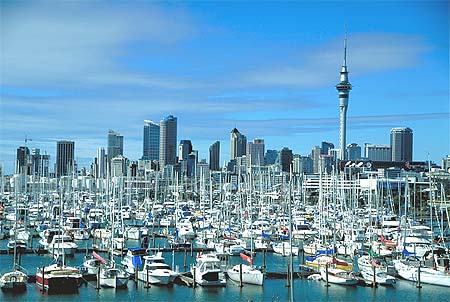
 A topic of discussion in the hallways at the conference is the creation by the national government of a new Auckland "Super City." This creates a new Auckland City Council combining eight existing cities into a new Auckland City Council on November 1, 2010. More info on the national government action here and the transition work being done in Auckland here. One reason this has been such a topic of conversation has been that the Chair of the conference, Rodger Kerr-Newell, is Chief Executive of a Council that is to eliminated by this consolidation and they are fighting it. See press account of all this here.
Saturday, April 24, 2010
Auckland Super City
A topic of discussion in the hallways at the conference is the creation by the national government of a new Auckland "Super City." This creates a new Auckland City Council combining eight existing cities into a new Auckland City Council on November 1, 2010. More info on the national government action here and the transition work being done in Auckland here. One reason this has been such a topic of conversation has been that the Chair of the conference, Rodger Kerr-Newell, is Chief Executive of a Council that is to eliminated by this consolidation and they are fighting it. See press account of all this here.

Conference Chairperson Summation
 Since the conference was hosted by three associations, there was no one person who was naturally the chair of the meeting. So SOLGM selected Rodger Kerr-Newell, the Chief Executive of Rodney District Council.
 Kerr-Newell is a senior New Zealand manager, apparently very well known in these parts. He chaired the meeting with a cross between Johnny Carson and Peter O'Toole. He did a great job keeping things on track, but not too formal.
Kerr-Newell was given thirty minutes at the end of Friday (he took ten minutes) to sum up the proceedings. He said he came away with two big issues from the conference:
1. Sustainability is an idea communities need to seek. Sustainability programs do not just happen in a community, but residents and local government managers must actively work to make the programs happen in their communities.
2. Sustainability to be successful in communities can not remain the work of environmentalists, as he put it "the dark corner of society." To be successful, sustainability must be part of a communities larger social, economic and cultural agenda. There must be recognition in the community of this broader based approach. Sustainability must also have a broader based pay off for communities that can be measured on many levels, including how sustainability practices can utimately save communities money.
Well put.
Sarasota County, Florida
 The final of the six presentations was from the only US jurisdiction, Sarasota County, Florida. Sarasota has developed a comprehensive countywide plan to address sustainability issues. What sets Sarasota County apart from what other communities are doing in this area is their determination to include sustainable practices into everything they do.
Newcastle City Council
 Newcastle City Council in Australia gave a presentation of their white paper on ClimateCam, the world's first greenhouse gas speedometer. The approach here is to widely involvement the community in many efforts of sustainability and to have the community keep track of its efforts to impact change through the use of a speedometer that shows exactly where the community is in meeting its goals. I can not really do justice to the breadth of the ClimateCam program here, but it is one of the most comprehensive community sustainability programs in the world. It has also been going on for over ten years, so its maturity is also one of the reasons for its comprehensiveness. It takes Newcastle four full time employees to support this initiative, plus the work of countless community and business partners.
Hunter Councils
 Friday's presentations started off with Hunter Councils, a consortium of twelve local governments in Australia. This consortium brings together these municipalities to provide centralized training, records storage, procurement and environmental planning. This is a model that has certainly done well in the United States, but I never heard of one of these entities doing records storage. Given the large amount of effort I know that Evanston does in this area, it is a great idea to include records storage in such a consortium. More info on records storage from Hunter Councils here.
Newspapers

The newspapers here are huge. I still had a section of last Sunday's New York Times with me to demonstrate the vast difference in size.
Friday, April 23, 2010
Rainbow Springs
 After the events of the Maori village, we went on a tour of the Rainbow Springs Kiwi Wildlife Park. The park is literally next door to the Maori Village. We saw real Kiwis and walked around the park which is nice lit at night as the photo above illustrates.
Mitai Maori Village
A group of us Thursday night went to the Mitai Maori Village for dinner and a demonstration of Maori culture (think Hawaiian Luau and show in Hawaii). Video from their website.
Keynote Speaker - Recession Impacts on US, NZ and Australia
The main program of Thursday afternoon was the keynote address by ICMA Executive Director Bob O'Neill talking about the US recession and its impacts on local governments. Since the main audience of this blog is in the USA and have been living through this, let me leave what Bob talked about for later in this post. I want to focus on the comments of the Presidents of New Zealand and Australia city manager associations said in response to Bob's comments at the conclusion of his remarks.
In short, things have been OK in both countries. In Australia, Neil Hartley the President of the Australia group said that things were fine the last few years but were tightening a little bit now. Australia had a national government stimulus package which Hartley indicated helped matters and that the banking industry in Australia is much more regulated than the US banking industrty was and is.
However in New Zealand, SOLGM President Steve Parry said that all remained well economically in the country. There was no national government stimulus package. Parry attributed the fiscal health to a healthy banking industry (most NZ banks are part of Australian banks), robust trade with Asian partners and that the national government continues to borrow money to support current operations. Parry said that there is some concern here how much longer this borrowing can still be done on the national level. All very interesting.
Bob O'Neill's talk focused on the research that ICMA has done in the past few years working with the Alliance for Innovation on ways US local governments are dealing with the recession. This work is compiled together on ICMA's economic crisis webpage. Bob also mentioned a wiki that is hosted by the Alliance that goes into the specific areas that local government managers can take advantage of the crisis to improve the organizations. These areas include:
What are the dimensions of the current crisis? What defines it?
What has worked in previous fiscal cutback efforts?
What characterizes organizations that cope better with fiscal stress?
Why is innovation in hard times so critical but how can positive actions be taken?
How can local government action contribute to the economic recovery?
Overall an excellent keynote session.
In short, things have been OK in both countries. In Australia, Neil Hartley the President of the Australia group said that things were fine the last few years but were tightening a little bit now. Australia had a national government stimulus package which Hartley indicated helped matters and that the banking industry in Australia is much more regulated than the US banking industrty was and is.
However in New Zealand, SOLGM President Steve Parry said that all remained well economically in the country. There was no national government stimulus package. Parry attributed the fiscal health to a healthy banking industry (most NZ banks are part of Australian banks), robust trade with Asian partners and that the national government continues to borrow money to support current operations. Parry said that there is some concern here how much longer this borrowing can still be done on the national level. All very interesting.
Bob O'Neill's talk focused on the research that ICMA has done in the past few years working with the Alliance for Innovation on ways US local governments are dealing with the recession. This work is compiled together on ICMA's economic crisis webpage. Bob also mentioned a wiki that is hosted by the Alliance that goes into the specific areas that local government managers can take advantage of the crisis to improve the organizations. These areas include:
What are the dimensions of the current crisis? What defines it?
What has worked in previous fiscal cutback efforts?
What characterizes organizations that cope better with fiscal stress?
Why is innovation in hard times so critical but how can positive actions be taken?
How can local government action contribute to the economic recovery?
Overall an excellent keynote session.
Waitakere City Council
 The final case study of Thursday was from the Waitakere City Council in New Zealand on its Project Twin Streams. Project Twin Streams is an urban sustainability initiative project which aims to restore 56kms of stream banks through an integrated community development approach. By engaging local communities and residents via community organizations, the streambanks were weeded, replanted with natives and maintained. The project is about many things: community engagement, stream health, natural environment and the health and recreation of people and their community. This case study was another great example of how community involvement can solve difficult environmental problems.
Salisbury, South Australia
 The City of Salisbury was next with their presentation on its Brahma Green Affordable Housing Project.
The City of Salisbury is growing at an unprecedented rate due to a rapidly expanding economy. While job opportunities continue to be created, national and international trends placed home ownership out of reach to many existing residents of Salisbury and it was becoming increasingly difficult for key workers on modest incomes such as teachers, nurses, and industry labour to live and work within the city. The Brahma Green Affordable Housing Project aims to assist first home buyers who would otherwise be unable to enter the housing market by converting surplus City land into a form of shared equity in the property.
Working in partnership with HomeStart Finance (a state organized financing entity), a unique legal and financial model including a shared appreciation/deferred payment mortgage was developed. The City's equity contribution to the project enables the purchaser to significantly increase their borrowing capacity. When the property is sold, the City will recoup the value of its stake, plus a share in the property’s appreciated value. Alternatively, the purchaser can choose to buy out City’s share. The City Council sought to achieve high standards of aesthetics, environmental outcomes, energy efficiency and low ongoing maintenance costs. The eleven homes all have a seven star energy efficiency rating and access to recycled stormwater.
More info on financing piece here (PDF).
This sort of project is not uncommon in US, but great to see Australian's taking best practice and implementing to meet their needs.
Whistler, British Columbia
 Whistler, British Columbia was first up to give their presentation Thursday on their 2020 community vision plan. The community centered its vision plan on sustainability. Whistler is a small resort town north of Vancouver which has just finished playing host to many 2010 Winter Olympic events. Their presentation on the 2020 plan was outstanding in how it keeps the community involved in the implementation of the plan. The key element of this is an outstanding web application that people can call up to see measureable progress on the implementation of the plan.
The extensive community process they used to develop the plan has spun off the Whistler Center for Sustainability which helps other communities do just this same kind of initiative.
I am wonking about stuff like this and I was absolutely impressed how Whistler grew a community planning process that most of us undertake and made it so much more meaningful to the community.
Thursday, April 22, 2010
Opening Ceremony
The conference had an opening ceremony. My experience tells me that most international local government management gathers do. Today's ceremony featured a traditional Maori welcoming ceremony called a Powhiri. The video clip is about a minute of the five to eight minute ceremony.
We were then safe to hear greetings from the Presidents of the Australian and New Zealand local government managers groups and from Simon Farbrother, an ICMA International Vice President and City Manager of Edmonton, Alberta.
International Best Practices Conference
The ICMA International Committee is here in Rotorua to support the 2010 International Best Practices Conference. These conferences have been held every two years rotating between Australia and New Zealand. These conferences focus on six best practice case studies presented by local government managers from Australia, New Zealand, Canada and the United States. The full program for the conference can be found here.
Study Tour Around Rotorua
 The Rotorua District Council hosted a group of us here for the meetings this week to a study tour Wednesday around the area with a conversation focus.
There are many lakes in the region, but two of the largest are Lake Rotorua and Lake Rotoiti (pictured). Rotorua welcomes over half a million international visitors each year. Lake Rotoiti is a key tourism asset for Rotorua, but its water quality has been deteriorating over many years, and this deterioration has become significantly worse in the last few years. Excessive nutrient inputs from septic tanks, livestock and other farming practices is the main cause of the lake's degradation. As well as affecting the lake's use for tourism, the lake's algal blooms are also becoming a public health concern.
In March 2008, the New Zealand national government committed $72.1 million over ten years to see the Rotorua Lakes Protection and Restoration Program implemented – this amounts to 50 per cent of the total cost. The Rotorua Lakes Protection and Restoration Program aims to restore four priority lakes: Rotorua, Rotoiti, Okareka, and Rotoehu. The program includes measures to address the different sources of nutrients entering those four priority lakes. Key components include sewerage works, treatment or diversion of nutrient-rich streams, capping lake sediments to lock up nutrients, construction of wetlands, and land management changes.
After a brief lunch at the District Council offices we went to Scion which is a Crown Research Institute dedicated to building the international competitiveness of the New Zealand forest industry and building a stronger biobased economy. Scion has partnered with the Rotorua District Council on basic research on how best to recycle the sludge created from the waste water treatment process. The District Council is funding a project to help Scion determine the best ways to convert this sludge into energy. More info on project here. Another team is working to develop methods improve lake water quality with pilot programs inserting minerals into lakes to change their chemistry to improve overall water quality.
The big take away from these visits is the importance of using local research resources nearby to solve local problems. Especially important for us city managers who serve in University communities.
About Rotorua
 Rotorua is located on the North Island of New Zealand. It is a community of 65,000 people 145 miles south of Auckland. It is a popular tourist destination (see its Visitor website), especially known for its geothermal activity and native Maori cultural sites. The Maori are the indigenous Polynesian people of New Zealand.
Local government here is provided by the Rotorua District Council. The City Council has a Mayor and twelve Councilmembers (four wards electing three members each). They hire a Chief Executive (the British term for City Manager) to run the city under the Council-Manager form of government. Just like Evanston. A management org chart is provided for your convenience. Always amazing how similar things are here in NZ local government wise to USA.
Transit to New Zealand
Transit from Chicago to Auckland was wonderfully uneventful. Driving from Auckland to Rotorua (at 6:00 AM) we saw some great highway safety signs. Simple, modern and to the point (especially about driving and talking on cell phone). Unfortunately, it was dark when we passed the signs and I was not thinking to get photos at that hour. Can't seem to find photos on Internet either. I will get photos if we see them again in our travels. Lots of sheep and cattle on our drive to Rotorua.
Monday, April 19, 2010
Welcome to the Blog
This is the third blog I have done for the ICMA International Committee's Spring Meeting. The prior two were for meetings in Bratislava, Slovakia in 2009 and Bangalore, India in 2008. This year we are traveling to Rotorua, New Zealand. My wife Patrice and I leave Monday afternoon Chicago time for Los Angeles and then to Auckland, New Zealand.
As in most previous trips, the City does not pay for trip. I attend the ICMA meetings on City time, but I am responsible for the airfare, hotel and meals on these trips.
Note that I have set the time zone for the blog to Rotorua, so some initial blog entries will be a little time zone challenged. Evanston is 17 hours earlier than Rotorua.
As in most previous trips, the City does not pay for trip. I attend the ICMA meetings on City time, but I am responsible for the airfare, hotel and meals on these trips.
Note that I have set the time zone for the blog to Rotorua, so some initial blog entries will be a little time zone challenged. Evanston is 17 hours earlier than Rotorua.
Subscribe to:
Comments (Atom)

 Rotorua Time